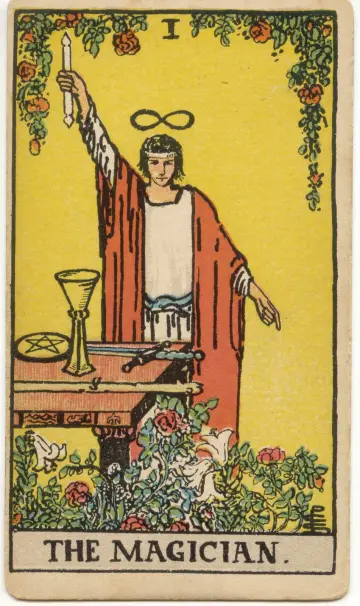
MAJOR ARCANA · I · MERCURY
The Magician Tarot Card Meaning
The Magician is card 1 of the Major Arcana, a young figure at a table with one hand raised to the sky and the other pointing to the ground. It is read as skill, willpower and the decision to start using what you already have.
The Magician at a glance
- ARCANA
- Major, card I (1)
- ELEMENT
- Air
- ASTROLOGY
- Mercury
- UPRIGHT
- skill, willpower, resourcefulness, initiative
- REVERSED
- manipulation, untapped talent, trickery, poor planning
- YES OR NO
- Yes upright · Maybe reversed
Yes or no? Upright, The Magician leans yes. Skill, will and initiative all favor acting now with what you have. Reversed, it leans maybe, meaning "not yet": the ability is there, but poor planning or unclear motives may need attention first.
Astrology: Golden Dawn attributions. Keywords and the yes/no lean are the site's summary of Waite's meanings. Draw a card: yes or no, card of the day, three-card reading.
Skill, diplomacy, address, subtlety; sickness, pain, loss, disaster, snares of enemies; self-confidence, will; the Querent, if male.
Reversed: Physician, Magus, mental disease, disgrace, disquiet.
A. E. Waite, The Pictorial Key to the Tarot (1910), divinatory meanings. Public domain.
The Magician upright meaning
Waite opens this card with "skill, diplomacy, address, subtlety" and adds self-confidence and will. In plain modern terms, that is the ability to read a situation, choose your words with care and act on what you know. "Address" here means a knack for approaching people and problems well. Waite's list also turns darker, with loss and snares set by enemies. Modern readers take that as a caution about being outmaneuvered, or about letting charm cover for a weak plan.
Skill and willpower sit at the center of the keywords. Resourcefulness and initiative follow from them: you work with what is already within reach and make the first move instead of waiting for ideal conditions. As the number 1, the card is read as a starting point, the moment a plan stops being only an idea.
Its astrology is Mercury, paired with the element Air. Mercury is traditionally linked with thought and communication, and Air carries the same mental tone. Together they point to a card about ideas turned into words and actions, and about persuasion that works best when it is honest.
Symbols in the 1909 card
Waite describes a youthful figure in a magician's robe, with a smile of confidence and shining eyes. Above his head hangs the sign of life, an endless cord lying on its side like an infinity symbol, read as a mind with room to keep going. A serpent circles his waist, swallowing its own tail, which Waite takes as the eternity of attainment in the spirit. His right hand holds a wand raised to heaven while the left points to the earth; Waite reads this as light drawn from above and passed down to things below, so the card is often taken as a link between an idea and its use. On the table lie the symbols of the tarot suits, elements of natural life that he adapts as he wills. Beneath him grow roses and lilies, wild flowers turned into garden flowers, which Waite calls the culture of aspiration.
The Magician reversed
Waite's reversed entry is short and gloomy: disgrace and disquiet, plus titles such as Physician and Magus. Modern readers set the titles aside and lean on the reversed keywords. Manipulation and trickery describe skill put to work for a hidden agenda, whether you are the one using it or the one on the receiving end. Untapped talent and poor planning point the other way. Ability sits unused, or a good idea falls apart because nobody worked out the steps. The reversed card may be asking whether your methods would hold up if everyone could see them, and what you have been putting off starting.
A card is reversed when it comes up upside down. Many readers take it as the card's meaning blocked, delayed or turned inward; some ignore reversals.
The Magician in love and as feelings
In a relationship reading, The Magician is read as confidence and initiative. It can point to someone who says what they want, makes the first move or puts real effort into how they communicate. Mercury and Air add the sense that talking, and talking honestly, matters here. Waite's mention of snares is a reminder that charm is not the same as sincerity, so notice whether words and actions match. As someone's feelings, the card can suggest they are interested, motivated and willing to act on it. Reversed, it may suggest mixed signals, flattery with an agenda, or affection that never gets put into words.
The Magician for work and ambition
At work, The Magician is read as an attitude: you have the skills, and the question is whether you will start. It can point to taking initiative, pitching an idea or making use of resources already in reach. Waite's "diplomacy" suggests that how you present your plan counts as much as the plan. Reversed, it may flag overpromising, spin or a talent that has been left idle.
The Magician and Mercury in 2027
The Magician is the card of Mercury. Mercury turns retrograde 3 times in 2027:
- February 9, 2027 – March 3, 2027, in Pisces and Aquarius
- June 10, 2027 – July 4, 2027, in Cancer and Gemini
- October 7, 2027 – October 28, 2027, in Scorpio and Libra
Exact times and what each period means: Mercury retrograde 2027.
Questions
✦Is The Magician a good card?
It is generally read as a positive card, built on skill and willpower, with initiative to start things. Waite's text also mentions snares of enemies, so it can carry a caution about charm used to mislead. Its tone depends on how you use what you have.
✦What does The Magician mean as feelings?
As someone's feelings, it is read as confidence and motivation, along with a wish to act instead of waiting. It can suggest they are putting effort into how they come across. Reversed, it may point to mixed signals or words that do not match actions.
✦What does The Magician reversed mean?
Reversed, it is read as manipulation, trickery, untapped talent or poor planning. Waite's own entry mentions disgrace and disquiet. Modern readers use it to ask whether skill is being misused or left idle.
By Dima Tretyak · Updated October 28, 2026 · For self-reflection, not prediction