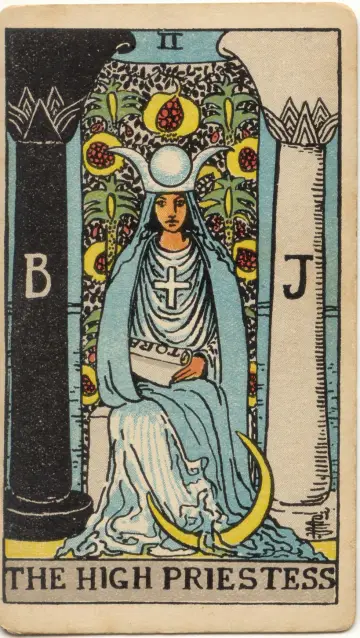
MAJOR ARCANA · II · MOON
The High Priestess Tarot Card Meaning
The High Priestess, numbered 2 (II) in the Major Arcana, stands for what stays unsaid. It is read as a prompt to listen inward before acting, and it belongs to Water and the Moon.
The High Priestess at a glance
- ARCANA
- Major, card II (2)
- ELEMENT
- Water
- ASTROLOGY
- Moon
- UPRIGHT
- intuition, hidden knowledge, silence, the inner voice
- REVERSED
- secrets, ignored intuition, surface knowledge, withdrawal
- YES OR NO
- Maybe upright · No reversed
Yes or no? Upright, The High Priestess leans maybe. Her message is that the answer is not fully revealed, so waiting and listening come before deciding. Reversed, she leans no: ignored intuition and surface knowledge suggest you are not ready to say yes.
Astrology: Golden Dawn attributions. Keywords and the yes/no lean are the site's summary of Waite's meanings. Draw a card: yes or no, card of the day, three-card reading.
Secrets, mystery, the future as yet unrevealed; the woman who interests the Querent, if male; the Querent herself, if female; silence, tenacity; mystery, wisdom, science.
Reversed: Passion, moral or physical ardor, conceit, surface knowledge.
A. E. Waite, The Pictorial Key to the Tarot (1910), divinatory meanings. Public domain.
The High Priestess upright meaning
Waite's list opens with "secrets, mystery, the future as yet unrevealed." In modern terms, she can point to a situation where the full picture is not available yet, and where pressing for answers may matter less than paying attention. Hidden knowledge is the keyword that fits best. Something may be known to you at a level you have not put into words, or something may be held back by another person.
Waite also names "silence, tenacity" and "wisdom, science." Silence is read here as a choice, not an absence: staying quiet long enough to hear what you already think. Tenacity suggests patience, holding your position without needing to defend it. "Science" in Waite's day meant knowledge, so she leans toward study and understanding over guesswork. The inner voice, another keyword, is her plainest message. It is a quiet sense that deserves a hearing even when you cannot yet explain it.
Waite adds that she can stand for the woman who interests the querent, or for the querent herself. Modern readers usually drop that gendered setup and treat her as the part of you, or a person in your life, who watches and keeps counsel. Her Water element covers feeling and mood, and her Moon attribution adds the idea of light that is reflected, not produced. Waite himself calls her the "Queen of the borrowed light." She is read as sensing and absorbing before you speak.
Symbols in the 1909 card
Start at her feet, where the lunar crescent ties her to the Moon. On her head sits a horned diadem with a globe in the middle, and a large solar cross rests on her breast. The scroll in her hands is marked Tora, which Waite glosses as the Greater Law, the Secret Law and the second sense of the Word. Her mantle covers part of it, to show that some things are implied and some spoken. Readers take this as her advice to share only part of what you know. She sits between the white and black pillars, J and B, which are read as a balance of opposites. Behind her hangs the veil of the Temple, embroidered with palms and pomegranates. It marks a threshold she guards and does not cross for you. Her gauzy robes and shimmering mantle suggest a radiance that is reflected.
The High Priestess reversed
Waite's reversed list is short: "passion, moral or physical ardor, conceit, surface knowledge." In modern readings that becomes a swing away from her stillness. Strong feeling or certainty takes over, and the quiet inner voice gets drowned out. Surface knowledge is the sharpest warning: you may know the headline but not what lies under it. The keywords add secrets, ignored intuition and withdrawal. A secret may be kept too long, a gut feeling may be brushed aside, or silence may turn into pulling away from people. The question she raises is whether you are listening or only waiting to be right.
A card is reversed when it comes up upside down. Many readers take it as the card's meaning blocked, delayed or turned inward; some ignore reversals.
The High Priestess in love and as feelings
In a relationship reading, The High Priestess points to depth that has not been spoken aloud. There may be feelings, on your side or your partner's, that sit below the surface, and she suggests listening and watching before pushing for a conversation. Her silence can also mean reserve, so trust may build slowly. If you are single, it can describe a time for knowing your own mind before seeking company. As someone's feelings, she is read as a person who feels a lot but shows little. Their interest may be real and still guarded, which makes patience more useful than pressure.
The High Priestess for work and ambition
At work, she is read as an attitude, not an outcome. She favors observing before speaking, studying a problem properly and trusting a quiet instinct about a colleague or a choice. Tenacity fits here: you can hold your position calmly without explaining every reason. Keep in mind that her mantle covers part of the scroll, so deciding what to share and what to keep to yourself can be a skill. Reversed, she warns against acting on surface knowledge.
Questions
✦Is The High Priestess a good card?
It is generally read as neutral to positive, since it values intuition and patience. Its challenge is that answers are not yet clear. Reversed, it can point to ignored instincts or secrets held too long.
✦What does The High Priestess mean as feelings?
As someone's feelings, she is read as strong emotion that is kept private. The person may care deeply but show little, and may be waiting to feel safe before saying so. It points to reserve more than to indifference.
✦What does The High Priestess mean reversed?
Waite names passion and conceit, along with surface knowledge. Modern readers take this as ignoring your intuition or acting on half-understood information. It can also mean withdrawing from others, or a secret that has been kept past its usefulness.
By Dima Tretyak · Updated October 28, 2026 · For self-reflection, not prediction