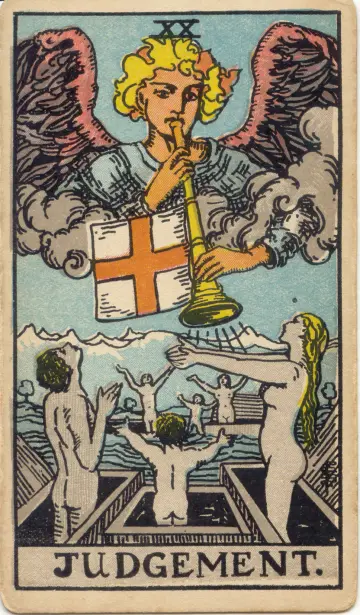
MAJOR ARCANA · XX · FIRE (ELEMENT)
Judgement Tarot Card Meaning
Judgement is number 20 of the Major Arcana, an angel's trumpet call that raises the figures from their tombs. It is read as a moment of renewal, reckoning and decision, tied to the element Fire.
Judgement at a glance
- ARCANA
- Major, card XX (20)
- ELEMENT
- Fire
- ASTROLOGY
- Fire (element)
- NUMBER
- 20 → 2 + 0 = 2, The High Priestess
- UPRIGHT
- renewal, reckoning, a calling, decision
- REVERSED
- self-doubt, harsh self-judgment, ignoring a calling, delay
- YES OR NO
- Yes upright · Maybe reversed
Yes or no? Upright, Judgement leans yes. Renewal and decision both move forward, and in Waite's notes the summons is answered. Reversed it leans maybe: self-doubt and delay read as "not yet", with the answer waiting on you.
Astrology: Golden Dawn attributions. Keywords and the yes/no lean are the site's summary of Waite's meanings. Draw a card: yes or no, card of the day, three-card reading.
Change of position, renewal, outcome. Another account specifies total loss through lawsuit.
Reversed: Weakness, pusillanimity, simplicity; also deliberation, decision, sentence.
A. E. Waite, The Pictorial Key to the Tarot (1910), divinatory meanings. Public domain.
Judgement upright meaning
Waite's short list for Judgement reads "change of position, renewal, outcome." In modern terms that is a point where you stop standing where you have been standing: the picture shows figures who lay still and are now upright with open arms. Renewal is the lead keyword, and Waite's longer notes call this the image of "the great work of transformation" in answer to a summons "heard and answered from within." So the call is read as coming from you, not from a judge.
Reckoning and decision are the keywords closest to the trumpet. A trumpet call asks for an answer, and Judgement is read as the moment you add up what has happened and choose. A calling, the third keyword, fits Waite's question about what within us sounds a trumpet so that all that is lower in our nature rises "almost in a moment." Fire, its element, suits that speed: it is read as a warm, sudden clarity that is hard to ignore.
Waite also quotes an account that predicts total loss; modern readings leave that out. The number 20 reduces to 2, The High Priestess, which pairs the loud trumpet with the quieter idea of listening inward.
Symbols in the 1909 card
Waite's notes begin with the great angel, wrapped in clouds and blowing a bannered trumpet. The cross on the banner is displayed "as usual", he says, and it ties the scene to the Last Judgment, which he allows the design to keep depicting for those who want that reading. Below, the dead rise from their tombs: a woman on the right, a man on the left and a child between them, back turned. The tombs are where they lay, so rising is read as getting up from a fixed position. Waite points out that this trump shows a larger crowd than that family group, a variation he offers to show how thin the usual explanations are. He also stresses that every figure shares the same wonder, adoration and ecstasy. Nobody cowers, so the scene is read as an answer given gladly rather than a sentence dreaded.
Judgement reversed
Waite's reversed list opens with "weakness, pusillanimity, simplicity." In plain terms that means timidity, a loss of nerve when the trumpet sounds. It fits the keywords self-doubt and delay: you hear the call and stall. His second group, "deliberation, decision, sentence," points toward mulling a matter over. The word sentence can be read as a verdict you pass on yourself, which is where harsh self-judgment comes in. In the upright picture everyone rises in wonder; reversed, it is as if you stay beside the tomb, going over the case against yourself and ignoring a calling you have already heard.
A card is reversed when it comes up upside down. Many readers take it as the card's meaning blocked, delayed or turned inward; some ignore reversals.
Judgement in love and as feelings
In a relationship reading, Judgement can point to a reckoning: a conversation where both people say where they stand, echoing Waite's "change of position." Renewal is the hopeful side, such as a bond that picks itself up after a quiet stretch. Decision is the harder side, because the trumpet asks for an answer. If you are single, it may suggest hearing what you actually want before you look for anyone. As someone's feelings, it is read as a person who has been thinking things over and feels pulled to act, with something close to the wonder Waite sees in the figures. They may still be reassessing, so Judgement says little about how that decision will land.
Judgement for work and ambition
At work, the calling keyword is the one to use. It can point to a question about whether your present role fits what you feel drawn to. Waite's "change of position" is read here as a change in attitude or stance, and decision as picking a direction rather than drifting. Fire adds urgency, so Judgement may appear when staying put has started to feel like a refusal to answer.
Questions
✦Is Judgement a good card?
It is mostly read as hopeful. Waite lists renewal, and his figures rise in wonder and adoration. It does ask for a decision, though, which can be uncomfortable, and reversed it can turn toward harsh self-judgment.
✦What does Judgement mean as feelings?
As someone's feelings, Judgement is read as a person who has weighed things up and feels called to act. It can show clarity, even relief, but it may also mean they are still reassessing and have not yet decided.
✦Why is Judgement a Fire card?
Its astrological attribution is the element Fire, which is read as sudden and warm. That matches Waite's description of the lower nature rising "almost in a moment, almost in the twinkling of an eye" when the trumpet sounds.
By Dima Tretyak · Updated October 28, 2026 · For self-reflection, not prediction