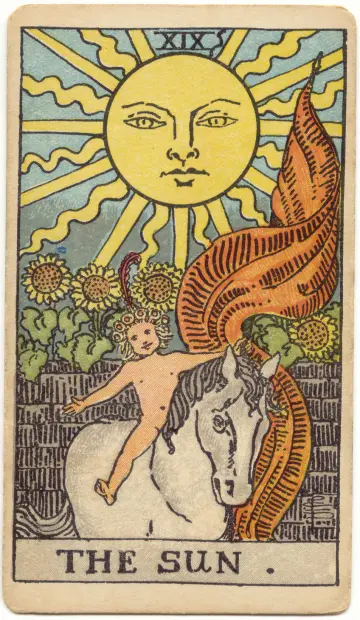
MAJOR ARCANA · XIX · SUN
The Sun Tarot Card Meaning
The Sun is trump 19 of the Major Arcana, read as joy, vitality and plain contentment. Waite's image is a naked child on a white horse carrying a red standard, and that picture shapes almost every reading of it.
The Sun at a glance
- ARCANA
- Major, card XIX (19)
- ELEMENT
- Fire
- ASTROLOGY
- Sun
- NUMBER
- 19 → 1 + 9 = 10, Wheel of Fortune
- UPRIGHT
- joy, success, vitality, contentment
- REVERSED
- temporary setbacks, dimmed enthusiasm, overconfidence, delayed success
- YES OR NO
- Yes upright · Maybe reversed
Yes or no? Upright, The Sun leans yes. Its meaning of joy and vitality, along with contentment, is wholly positive. Reversed, it leans maybe: Waite's "the same in a lesser sense" and the keyword delayed success suggest a yes that is not quite ready.
Astrology: Golden Dawn attributions. Keywords and the yes/no lean are the site's summary of Waite's meanings. Draw a card: yes or no, card of the day, three-card reading.
Material happiness, fortunate marriage, contentment.
Reversed: The same in a lesser sense.
A. E. Waite, The Pictorial Key to the Tarot (1910), divinatory meanings. Public domain.
The Sun upright meaning
Waite's short list for the upright Sun is "material happiness, fortunate marriage, contentment." In modern terms, that points to a sense of things being well: your circumstances feel comfortable, and your close bonds feel steady and warm. Today the Sun is rarely tied to marriage specifically. It is more often read as a general sign of ease with the people and situations around you.
The keywords reinforce that tone. Joy is the most direct: the Sun can point to enjoyment that needs no justification. Success and vitality lean toward energy and confidence, the feeling that your effort is landing well. Contentment is the quietest of the four, and it may be the most useful one, since it suggests being satisfied with what is already here instead of reaching for the next thing.
Waite's longer notes describe the child as simplicity and innocence, a light that comes from direct awareness rather than reflection. Read plainly, this is openness without defensiveness. The Sun's attribution to the Sun and the element Fire adds warmth, visibility and energy. It also connects to the reduction, 19 to 10, the Wheel of Fortune, which can hint that this brightness belongs to a larger cycle and is one phase of it.
Symbols in the 1909 card
Waite's notes center on the naked child mounted on a white horse, displaying a red standard. The child is read as simplicity and innocence: someone with nothing to hide and nothing to prove. The white horse is the animal nature, which Waite says is led "in a state of perfect conformity" once awareness has dawned, so instinct and intention pull in the same direction. The red standard is the visible banner of that state, a sign of vitality carried openly. Waite also mentions a walled garden of the sensitive life, which the procession is leaving behind. In modern readings, this suggests stepping out of a sheltered or guarded way of living. The sun itself is, in his words, the "direct" light, as opposed to the reflected one. That can be read as seeing things as they are, not through someone else's glow.
The Sun reversed
Waite's note on the reversed Sun is brief: "the same in a lesser sense." So its good qualities remain, only dimmed. Modern keywords fill in the picture: temporary setbacks, dimmed enthusiasm, overconfidence and delayed success. A reversed Sun may suggest that the brightness is there but clouded, perhaps by a passing disappointment or by tiredness. It can also warn that too much certainty is hiding a detail you have missed. The word "temporary" matters here. This is usually read as a slower, patchier version of the upright Sun, not its opposite.
A card is reversed when it comes up upside down. Many readers take it as the card's meaning blocked, delayed or turned inward; some ignore reversals.
The Sun in love and as feelings
In a relationship reading, the Sun is read as warmth and ease. Waite's "fortunate marriage" translates to a bond where both people can be open, without games or guarded behavior. It may point to enjoying each other's company and feeling secure enough to be playful. For a single reader, the Sun can suggest meeting others with the child's openness: relaxed and honest, not hiding behind a role. As someone's feelings, it is read as happiness and affection that are plainly shown. The person may feel content with you and see no need to conceal it.
The Sun for work and ambition
At work, the Sun is read as confidence and energy about what you are doing. Waite's "contentment" can point to satisfaction in your tasks, not only ambition. It may suggest bringing the child's directness to a project: saying what you mean and carrying your standard openly. Reversed, it may be a prompt to check that enthusiasm is not turning into overconfidence.
Questions
✦Is The Sun a good card?
Yes, it is among the most positive in the deck. Waite lists material happiness and contentment, and modern keywords add joy and vitality. Reversed, it is usually just a dimmer version of the same.
✦What does The Sun mean as feelings?
As someone's feelings, The Sun is read as open, uncomplicated happiness and warm affection. Like the child in the picture, the person may have little to hide. It can point to contentment more than intensity.
✦What does The Sun mean reversed?
Waite calls it "the same in a lesser sense," so the good qualities are present but muted. Modern readings mention temporary setbacks and dimmed enthusiasm, along with overconfidence. It may be a nudge to check where your optimism has gone quiet or run ahead of the facts.
By Dima Tretyak · Updated October 28, 2026 · For self-reflection, not prediction