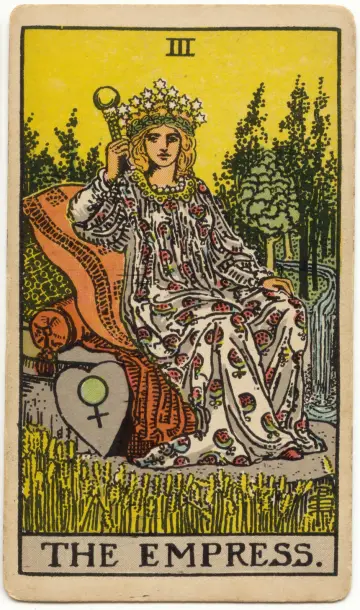
MAJOR ARCANA · III · VENUS
The Empress Tarot Card Meaning
The Empress is number 3 of the Major Arcana, shown as a seated, richly dressed figure with a field of ripening corn in front of her. It is read as growth that is being tended: abundance, nurturing, comfort and creativity.
The Empress at a glance
- ARCANA
- Major, card III (3)
- ELEMENT
- Earth
- ASTROLOGY
- Venus
- UPRIGHT
- abundance, nurturing, comfort, creativity
- REVERSED
- dependence, creative block, smothering, neglect of self
- YES OR NO
- Yes upright · Maybe reversed
Yes or no? Upright, The Empress leans yes: fruitfulness and ripening corn favor going ahead with something already growing. Reversed, it leans maybe, meaning "not yet." Smothering, dependence or a creative block suggest the answer needs more care before it can be a clear yes.
Astrology: Golden Dawn attributions. Keywords and the yes/no lean are the site's summary of Waite's meanings. Draw a card: yes or no, card of the day, three-card reading.
Fruitfulness, action, initiative, length of days; the unknown, clandestine; also difficulty, doubt, ignorance.
Reversed: Light, truth, the unravelling of involved matters, public rejoicings; according to another reading, vacillation.
A. E. Waite, The Pictorial Key to the Tarot (1910), divinatory meanings. Public domain.
The Empress upright meaning
Waite opens the upright meaning with "fruitfulness, action, initiative, length of days." In modern terms that describes something growing because it keeps being tended: a project, a household, a friendship. Abundance is the first keyword, and the picture supports it with a field of corn ripening in front of the seated figure. Ripening takes time, so The Empress is read as growth already underway rather than a sudden arrival.
His list then turns to "the unknown, clandestine" and "difficulty, doubt, ignorance." Waite's wording is Victorian; in modern readings it becomes a note that part of what is growing is not yet visible, such as an idea kept private or a feeling not yet said. Nurturing and comfort fill the rest of the picture. He calls her "the fruitful mother," and the keywords describe care given and received, a place where people feel looked after.
Venus is the astrology of The Empress, and Waite puts her symbol on the shield beside her seat. He also calls her "the Garden of Venus" and "the Earthly Paradise," so creativity here is tied to pleasure in the physical world. Earth, her element, keeps it practical: something grown, cooked, built or made by hand.
Symbols in the 1909 card
Waite describes a stately figure, seated, in rich vestments with a royal aspect, "as of a daughter of heaven and earth." That phrase is read as authority that belongs to both the spiritual and the physical sides of life. Her diadem of stars is gathered in a cluster, which fits the heaven half of that description. The shield near her carries the symbol of Venus, marking her link to love and pleasure. In front of her a field of corn is ripening, the plainest image of abundance in the picture. Beyond it a fall of water suggests a source that keeps the field supplied. Her scepter is topped with the globe of this world, so her power is exercised here, on the ground. Waite sums her up as "universal fecundity" and the gate by which one enters this life.
The Empress reversed
Waite's reversed meaning is surprisingly bright: "light, truth, the unravelling of involved matters, public rejoicings," with "vacillation" as another reading. In modern use that clarity is often set aside in favor of the upright keywords turned over. Nurturing can tip into smothering, where care becomes control. Comfort can become dependence on another person or on a routine. Creative block describes the field that is not ripening, and neglect of self describes a giver who tends everyone else's needs first. Waite's "vacillation" fits the stalled, undecided side of this. His "unravelling" offers a way through: seeing plainly which of these patterns applies.
A card is reversed when it comes up upside down. Many readers take it as the card's meaning blocked, delayed or turned inward; some ignore reversals.
The Empress in love and as feelings
In a relationship reading, The Empress points to affection that grows through steady care, like the corn ripening in her field. It can describe warmth, physical closeness, shared comfort at home, or a bond that feels generous on both sides. Venus, her planet, adds delight and appreciation to the picture. Reversed, the questions are whether care has become smothering or whether one person is relying too heavily on the other. As someone's feelings, she is read as fondness shown through looking after you, though Waite's word "clandestine" hints that it may be felt more than spoken.
The Empress for work and ambition
At work, The Empress is read as an attitude rather than a result. Waite's "initiative" and "action" suggest putting steady effort into something that needs time, the way corn needs a season. Creativity is the keyword most tied to career, so she can point to choosing work that lets you make things or look after people and projects. Reversed, it may show a creative block, or giving so much to others that your own plans go untended.
Questions
✦Is The Empress a good card?
The Empress is generally seen as a favorable pick. Waite's "fruitfulness" and the ripening corn in the picture point to growth, comfort and creativity. Waite also lists "doubt" and "the unknown," so it is not entirely without caution.
✦What does The Empress mean as feelings?
As someone's feelings, it is read as affection that shows itself through care and generosity. The Venus symbol on her shield ties it to love and appreciation. Waite's "clandestine" suggests the feeling may be present but not yet said aloud.
✦What does The Empress reversed mean?
Waite gives it a bright meaning of "light, truth" and the unravelling of tangled matters, plus "vacillation" as another reading. Modern readers more often use the keywords dependence, smothering, creative block and neglect of self. Both versions invite you to look at where care has become stuck or lopsided.
By Dima Tretyak · Updated October 28, 2026 · For self-reflection, not prediction