MAJOR ARCANA · XII · WATER (ELEMENT)
The Hanged Man Tarot Card Meaning
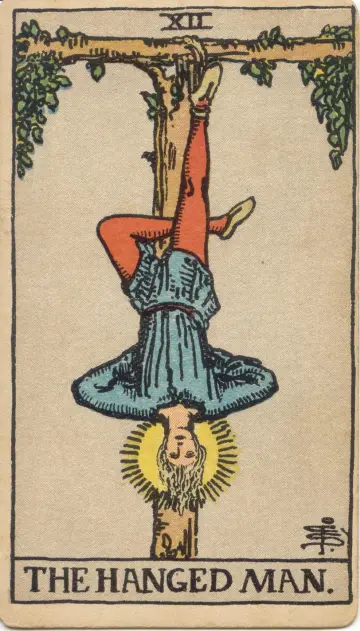
The Hanged Man, number 12 of the Major Arcana, shows a figure hanging calmly from living wood. It is read as a sign of pause and surrender, where letting go of control may open a different view of a situation.
The Hanged Man at a glance
- ARCANA
- Major, card XII (12)
- ELEMENT
- Water
- ASTROLOGY
- Water (element)
- NUMBER
- 12 → 1 + 2 = 3, The Empress
- UPRIGHT
- surrender, pause, a new perspective, sacrifice
- REVERSED
- stalling, needless sacrifice, indecision, resistance
- YES OR NO
- Maybe upright · No reversed
Yes or no? Upright, The Hanged Man leans maybe. Its themes of pause and surrender ask for waiting rather than an answer. Reversed, it leans no, because stalling, backed by resistance, suggests the pause has hardened into being stuck.
Astrology: Golden Dawn attributions. Keywords and the yes/no lean are the site's summary of Waite's meanings. Draw a card: yes or no, card of the day, three-card reading.
Wisdom, circumspection, discernment, trials, sacrifice, intuition, divination, prophecy.
Reversed: Selfishness, the crowd, body politic.
A. E. Waite, The Pictorial Key to the Tarot (1910), divinatory meanings. Public domain.
The Hanged Man upright meaning
Waite's list opens with wisdom, circumspection and discernment, then moves on to trials and sacrifice. In modern terms, that points to a stretch where pushing harder does not help and holding back to look carefully is the wiser move. He also lists intuition, so the image is often taken to favor an inner sense of what matters over a quick decision.
Surrender and pause are the lead keywords. Waite stresses that the face shows deep entrancement, not suffering, so giving up the struggle here is not defeat. You may be asked to leave something unresolved for a while and see what appears once you stop forcing it. A new perspective is the third keyword, and the upside-down figure is its plainest picture: the world looks different from there. Sacrifice, the fourth, can mean giving something up on purpose, such as a plan, a habit or the need to be right.
Water is its element, linked with feeling and intuition, and it suits an image about yielding rather than pushing. Add the number: 12 reduces to 3, The Empress, which can suggest that the waiting is not empty and that something may be growing while you hold still.
Symbols in the 1909 card
Waite says the gallows forms a Tau cross, while the figure's legs form a fylfot cross, so both frame and body carry cross shapes. The tree is living wood with leaves on it, which is read as sacrifice tied to growth rather than ruin. A nimbus surrounds the head, a sign that this seeming martyr is illuminated, not punished. Look at the face too: Waite sees entrancement, not suffering, so the hanging reads as accepted or chosen. He adds that the whole figure suggests life in suspension, but life and not death. Waite admits the deeper meaning stays veiled and rejects labels like martyrdom, prudence or duty. Modern readers keep that openness, treating the image as a question to sit with instead of a rule to follow.
The Hanged Man reversed
Waite's reversed meaning is short: selfishness, the crowd, body politic. In modern terms, the crowd can stand for following what everyone else does instead of taking the quiet pause the upright position offers. The keywords add stalling, needless sacrifice, indecision and resistance. Reversed, the hanging may stop being a chosen surrender and become a stuck position, where you wait because deciding feels uncomfortable. It can also point to giving things up that no one asked of you, or to refusing to let go of a view that no longer serves. The question it raises is whether the pause is still teaching you something or has simply become a habit.
A card is reversed when it comes up upside down. Many readers take it as the card's meaning blocked, delayed or turned inward; some ignore reversals.
The Hanged Man in love and as feelings
In a relationship reading, The Hanged Man is read as a pause in which neither person needs to force an answer. It can point to letting go of the need to win an argument, or to looking at a conflict from the other person's side, much like the upside-down view in the picture. Sacrifice appears here too, and the question may be whether what you are giving up is chosen or merely expected of you. As someone's feelings, it can describe a person who is suspended between options, unsure and reflective, not cold. Reversed, it may suggest stalling or resisting a conversation that is overdue.
The Hanged Man for work and ambition
At work, The Hanged Man is read as a time to step back from pushing and reconsider your approach. A new perspective may come from pausing a project, questioning an assumption or listening before you act. The sacrifice keyword can point to giving up a preferred plan for a better one. Reversed, it may describe indecision, or taking on extra burdens that are not yours to carry.
Questions
✦Is The Hanged Man a good card?
It is neither good nor bad. Waite's face of entrancement, not suffering, suggests the pause is meant to be accepted rather than feared. It can feel uncomfortable because it asks you to stop forcing things.
✦What does The Hanged Man mean as feelings?
As someone's feelings, it is read as hesitation and reflection. The person may be unsure, willing to wait, or looking at the situation from a new angle. Reversed, it can point to resistance or stalling.
✦What does The Hanged Man mean reversed?
Reversed, it points to stalling and needless sacrifice. Indecision sits close behind. Waite's own reversed meaning of selfishness can be read as clinging to your own view instead of pausing to rethink. His mention of the crowd can be read as following others.
By Dima Tretyak · Updated October 28, 2026 · For self-reflection, not prediction