MAJOR ARCANA · V · TAURUS
The Hierophant Tarot Card Meaning
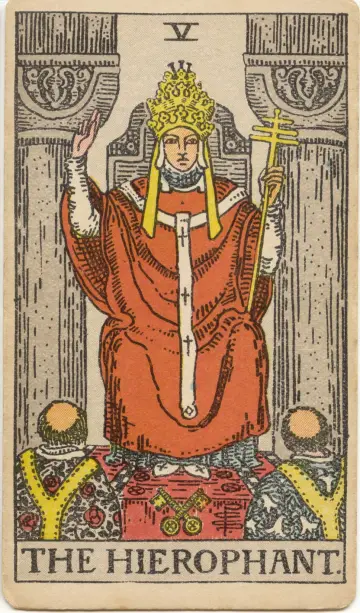
The Hierophant is the fifth of the Major Arcana, read as tradition, shared belief and the guidance of an established institution. Waite pictures a robed authority at the center of public, organized religion, and the figure still points to rules, teachers and commitments that others have agreed on.
The Hierophant at a glance
- ARCANA
- Major, card V (5)
- ELEMENT
- Earth
- ASTROLOGY
- Taurus
- UPRIGHT
- tradition, convention, teaching, shared beliefs
- REVERSED
- rebellion, unconventional paths, rigid rules, dogma
- YES OR NO
- Maybe upright · No reversed
Yes or no? Upright, the answer leans maybe. It favors established, agreed ways of doing things, but Waite's pairing of alliance and captivity leaves the answer open. Reversed, it leans no, because the reading then points to rigid rules or a break from convention.
Astrology: Golden Dawn attributions. Keywords and the yes/no lean are the site's summary of Waite's meanings. Draw a card: yes or no, card of the day, three-card reading.
Marriage, alliance, captivity, servitude; by another account, mercy and goodness; inspiration; the man to whom the Querent has recourse.
Reversed: Society, good understanding, concord, over-kindness, weakness.
A. E. Waite, The Pictorial Key to the Tarot (1910), divinatory meanings. Public domain.
The Hierophant upright meaning
Waite's list for the upright position opens with marriage, alliance, captivity and servitude. In modern terms, that is about commitments and the structures that come with them: a formal partnership, a group you belong to, a set of expectations you have accepted. Waite puts captivity next to alliance, and the pairing is worth keeping. The same framework that supports you can also hold you in place.
He adds "mercy and goodness" by another account, plus "inspiration" and "the man to whom the Querent has recourse." Today that last phrase is usually read as a mentor, teacher or trusted institution you turn to for guidance. The keywords fit: tradition, convention, teaching and shared beliefs all describe knowledge that has been handed down instead of invented on the spot. Waite himself says the figure is not inspiration and not religion itself, only a mode of its expression, so the focus is the outer form of belief more than any private spark.
The astrology adds a steady note. Taurus is an Earth sign, tied to patience and to trust in what has proven itself. Read together, they can suggest that a slow, tested path is worth considering before you break from it.
Symbols in the 1909 card
Waite describes a figure in a layered crown, seated between a pair of pillars. He notes these are not the pillars of the hidden temple, so this is a public setting, the face of external religion. The scepter ending in a triple cross is read as authority passed down through a recognized order. His raised right hand gives a sign that separates the revealed part of a doctrine from the concealed part. In readings, it hints that some things are taught openly and others are left to you to work out. Crossed keys lie at his feet, the "power of the keys," read as access granted through proper channels. A pair of priestly ministers in albs kneel before him, standing for students and followers who accept the structure. Waite warns that the figure can forget that he only represents something greater and act as if he were all of it.
The Hierophant reversed
Waite's reversed list is gentler than you might expect: it pairs society and good understanding with over-kindness and weakness. Modern readers often move the emphasis. Turned over, the figure can point to questioning the rules you were given, which matches the keywords rebellion and unconventional paths. It can also describe the opposite problem: rigid, dogmatic rules that no longer fit. Waite's "over-kindness" and "weakness" can be read as going along with a group to keep the peace when you disagree. The reversal may invite you to ask which conventions you still believe in and which you only follow out of habit.
A card is reversed when it comes up upside down. Many readers take it as the card's meaning blocked, delayed or turned inward; some ignore reversals.
The Hierophant in love and as feelings
In a relationship reading, this placement is often linked to Waite's "marriage" and "alliance": commitment that is recognized and shared with others. It can point to shared values, family expectations or a wish to define what the partnership is. As Earth and Taurus suggest, it may favor steadiness over novelty. Waite's "captivity" is the caution, since a relationship run purely by expectation can feel confining. As someone's feelings, it is read as a person who takes commitment seriously and wants things done properly, perhaps more comfortable with tradition than with improvisation. Reversed, it may show a wish to write your own terms.
The Hierophant for work and ambition
At work, The Hierophant is read as an attitude toward structure. It can point to learning from a mentor, following established methods, or valuing the guidance of an organization you respect. The keyword teaching suggests training or passing on what you know. Taurus adds patience and a preference for proven approaches. Reversed, it may ask whether a procedure still serves its purpose or has hardened into habit.
When the Sun is in Taurus in 2027
The Hierophant is the card of Taurus. In 2027 the Sun passes through Taurus from April 20, 2027 to May 21, 2027 (Eastern time), computed from the site's ephemeris. People born in that window have their Sun there; tarot readers who use the attribution treat it as the card's season.
Questions
✦Is The Hierophant a good card?
It is neither good nor bad on its own. Waite's list runs from alliance and mercy to captivity and servitude, so The Hierophant can mean supportive structure or confining rules. Context and your own situation decide which applies.
✦What does The Hierophant mean as feelings?
As someone's feelings, it is read as seriousness about commitment and respect for shared values or tradition. The person may prefer clear, agreed expectations over casual or undefined arrangements. It does not say how they feel about you specifically.
✦What does The Hierophant mean reversed?
Reversed, it is often read as questioning convention, leaning toward unconventional paths or pushing back on dogma. Waite's own list includes concord and over-kindness, which can describe going along with others too readily. The reversal may ask which rules you still agree with.
By Dima Tretyak · Updated October 28, 2026 · For self-reflection, not prediction