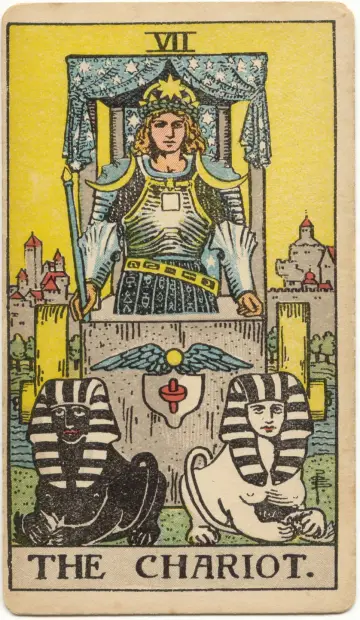
MAJOR ARCANA · VII · CANCER
The Chariot Tarot Card Meaning
The Chariot is number 7 in the Major Arcana, showing a princely figure with a drawn sword in a chariot pulled by sphinxes. It is read as willpower and control pointed at a clear aim, and Waite adds a caution: this victory is won on the outside, through reason.
The Chariot at a glance
- ARCANA
- Major, card VII (7)
- ELEMENT
- Water
- ASTROLOGY
- Cancer
- UPRIGHT
- willpower, victory, control, determination
- REVERSED
- loss of direction, scattered effort, aggression, obstacles
- YES OR NO
- Yes upright · Maybe reversed
Yes or no? Upright, the lean is yes: Waite's "succor" and "triumph" favor going ahead, though "presumption" says to check your assumptions first. Reversed, it leans maybe, closer to "not yet", because scattered effort and loss of direction need settling before the push.
Astrology: Golden Dawn attributions. Keywords and the yes/no lean are the site's summary of Waite's meanings. Draw a card: yes or no, card of the day, three-card reading.
Succor, providence; also war, triumph, presumption, vengeance, trouble.
Reversed: Riot, quarrel, dispute, litigation, defeat.
A. E. Waite, The Pictorial Key to the Tarot (1910), divinatory meanings. Public domain.
The Chariot upright meaning
Waite's list for The Chariot opens gently with "succor, providence" and then turns harder: "war, triumph, presumption, vengeance, trouble." In modern terms that describes effort that can pay off in a win, along with the pride and friction that often come with winning. He calls the figure "triumph in the mind", conquest in thought, science and progress rather than a quiet inner peace.
The keywords are willpower, victory, control and determination. Read together, they describe a decision made and then held: you choose a direction and keep steering. Waite says the charioteer has "replied to the Sphinx", so what pulls him along is something he has already faced. The Chariot is not about avoiding difficulty. It is about having worked through a question well enough to move forward.
Waite also lists the limits of this success. The planes of his conquest are "manifest or external and not within himself", and the liberation he brings may leave him "in the bondage of the logical understanding". Read modernly, The Chariot can point to a real achievement that still leaves some inner questions open. The astrology adds a layer. The Golden Dawn tradition links it to Cancer, a Water sign, and some readers take that as a prompt to ask what feeling sits underneath the drive.
Symbols in the 1909 card
Waite describes an "erect and princely figure carrying a drawn sword". The upright posture and bare blade are read as readiness and a will that is already made up. He says the Urim and Thummim are "supposed to be" on the figure's shoulders, which readers take as authority that comes with the role. Two sphinxes draw the chariot, a variation Waite accepts from Eliphas Lévi. Because the charioteer has answered the Sphinx, these creatures are read as a question he has met, now turned into forward motion. Waite says he has "led captivity captive", a phrase for conquest that frees as well as wins. He adds that the figure is "not hereditary royalty" and "not priesthood", so the standing shown here is earned by effort, not inherited or granted by office.
The Chariot reversed
Waite's reversed list is "riot, quarrel, dispute, litigation, defeat". Modern readings keep the sense of conflict and drop the courtroom wording: this is friction, not a forecast of any outcome. The reversed keywords are loss of direction, scattered effort, aggression and obstacles. With the sword no longer clearly aimed, force can turn into pushing at whoever is nearby. Waite's own point that the charioteer's conquests are external gives the reversal a second angle: winning an argument or a contest may be getting in the way of asking what you actually wanted from it. It can invite you to pick one aim before spending more effort.
A card is reversed when it comes up upside down. Many readers take it as the card's meaning blocked, delayed or turned inward; some ignore reversals.
The Chariot in love and as feelings
In a relationship reading, The Chariot can point to a partnership that moves because both people have chosen the same direction, or to one person who is driving too hard. Waite's "presumption" is a useful flag here: it asks whether you are assuming what the other person wants. His note that the charioteer wins through reason, not inner understanding, suggests it can describe commitment that is firm but not yet deeply felt. Reversed, it may show arguments where each person is trying to win. As someone's feelings, it is read as determination: strong interest, a wish to pursue it, and a will to act on it. With its link to Cancer and Water, that drive may be tied to deeper feeling than it first appears.
The Chariot for work and ambition
At work, The Chariot is read as commitment to a path you have chosen. Waite's "triumph in the mind" fits study, planning and solving a hard problem by thinking it through. Determination and control are the keywords, so it can ask whether your effort is aimed at one goal. Waite's "presumption" and "vengeance" are the warnings: pride or a wish to beat a rival can steer worse than a clear purpose. Reversed, scattered effort suggests too many demands pulling in different directions.
When the Sun is in Cancer in 2027
The Chariot is the card of Cancer. In 2027 the Sun passes through Cancer from June 21, 2027 to July 22, 2027 (Eastern time), computed from the site's ephemeris. People born in that window have their Sun there; tarot readers who use the attribution treat it as the card's season.
Questions
✦Is The Chariot a good card?
Mostly yes. Willpower and victory are among its upright keywords, so it is generally read as favorable. Waite's list has a second side, though: it places "presumption" and "trouble" next to "triumph". A win may be on the way, and pride is worth watching.
✦What does The Chariot mean as feelings?
As someone's feelings, it is read as determination: a person who has decided what they want and is moving toward it. The Cancer and Water link can suggest real feeling behind that drive, but Waite's charioteer wins by reason, so the feeling may not be openly shown.
✦Why does The Chariot have sphinxes instead of horses?
Waite says he accepted this variation from Eliphas Lévi, and that the charioteer has answered the Sphinx. The creatures are read as a question he has already met. That makes the pull of the chariot a sign of mastery, though Waite notes that mastery is mainly of the outer world.
By Dima Tretyak · Updated October 28, 2026 · For self-reflection, not prediction